

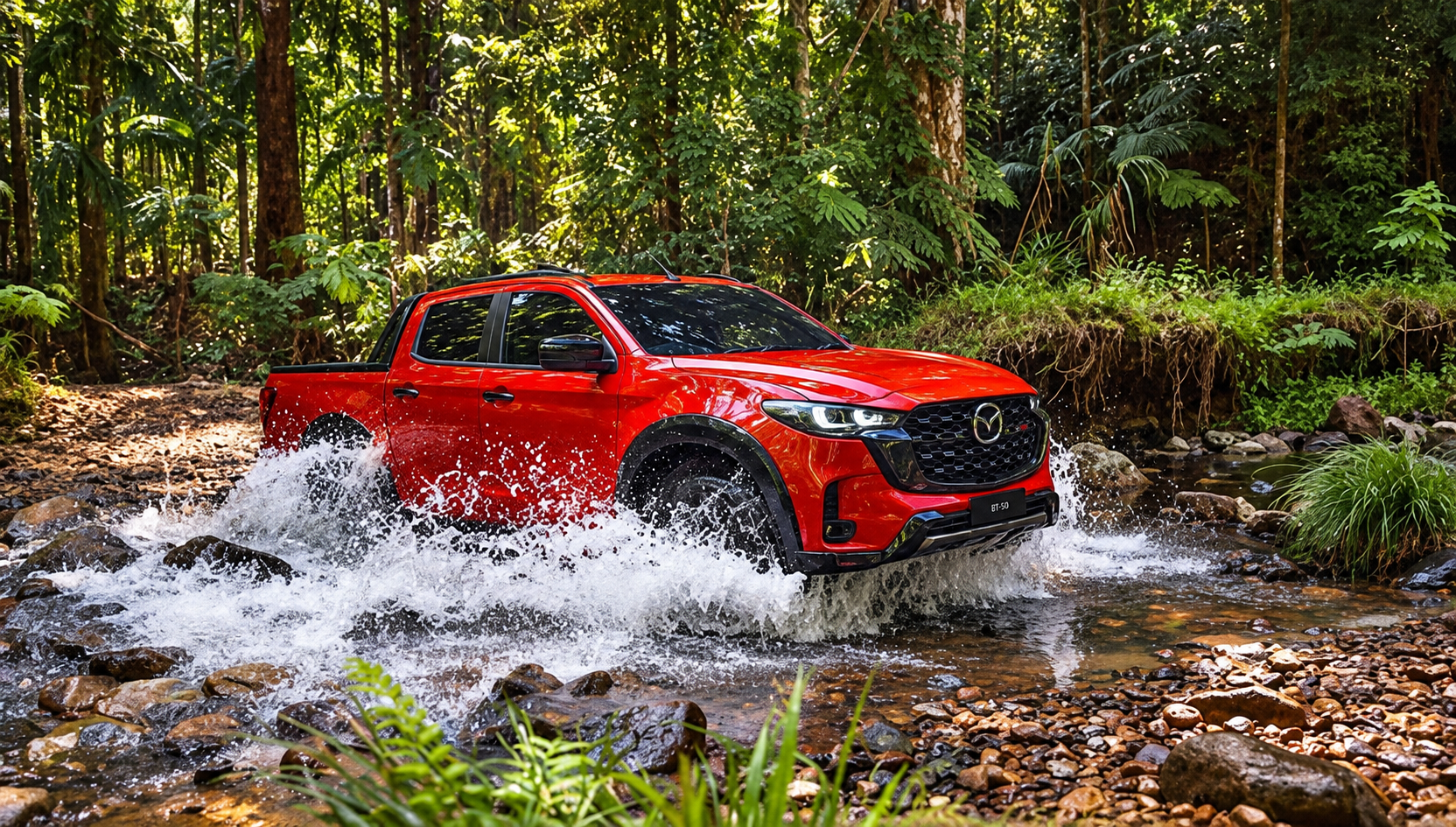
Mazda is preparing to bring the BT-50 bakkie into a new generation, with the Japanese automaker indicating that a global launch could take place in 2028.
Mazda chief designer Eiji Kimoto, who was involved in the development of the current BT-50, has reportedly confirmed that work on its replacement is underway, although the company has yet to reveal details about the design or technical direction.
Mazda BT-50 Set for a New Generation
The current BT-50 is based on the Isuzu D-Max platform, marking a significant departure from earlier generations that shared Ford’s ladder-frame architecture.
Rather than jointly developing the vehicle with Isuzu, Mazda sourced the platform and applied its own Kodo design language to create a distinct exterior.
The current Thai-built BT-50 is offered in international markets with 1.9-litre, 2.2-litre and 3.0-litre four-cylinder turbodiesel engines, paired with either a six-speed manual or six-speed automatic transmission.
Available body configurations include single-cab, extended-cab and double-cab versions.
Could the BT-50 Return to South Africa?
Mazda South Africa discontinued the BT-50 locally in March 2024, around four years after the third-generation model was introduced.
The decision followed relatively weak local market reception, although the BT-50 has continued to be sold in international markets.
For the next generation, Mazda’s direction remains unclear. The company could potentially continue its relationship with Isuzu, explore another platform partnership or leverage its existing relationship with Changan.
Design could also play a major role, with the next BT-50 potentially adopting elements of Mazda’s latest Kodo design language seen on newer models.
2028 Global Launch Could Open the Door to South Africa
Mazda has not confirmed whether the next BT-50 will return to South Africa. However, the country’s strong bakkie market and similarities with other right-hand-drive markets such as Australia could create an opportunity for a local reintroduction.
If Mazda can establish a commercially viable proposition, the new-generation BT-50 could once again compete in South Africa’s highly competitive bakkie segment.
