

Physicists have found strong evidence of quantum entanglement between pairs of Z bosons produced at the Large Hadron Collider (LHC), opening a new window into quantum mechanics at some of the highest energies ever studied.
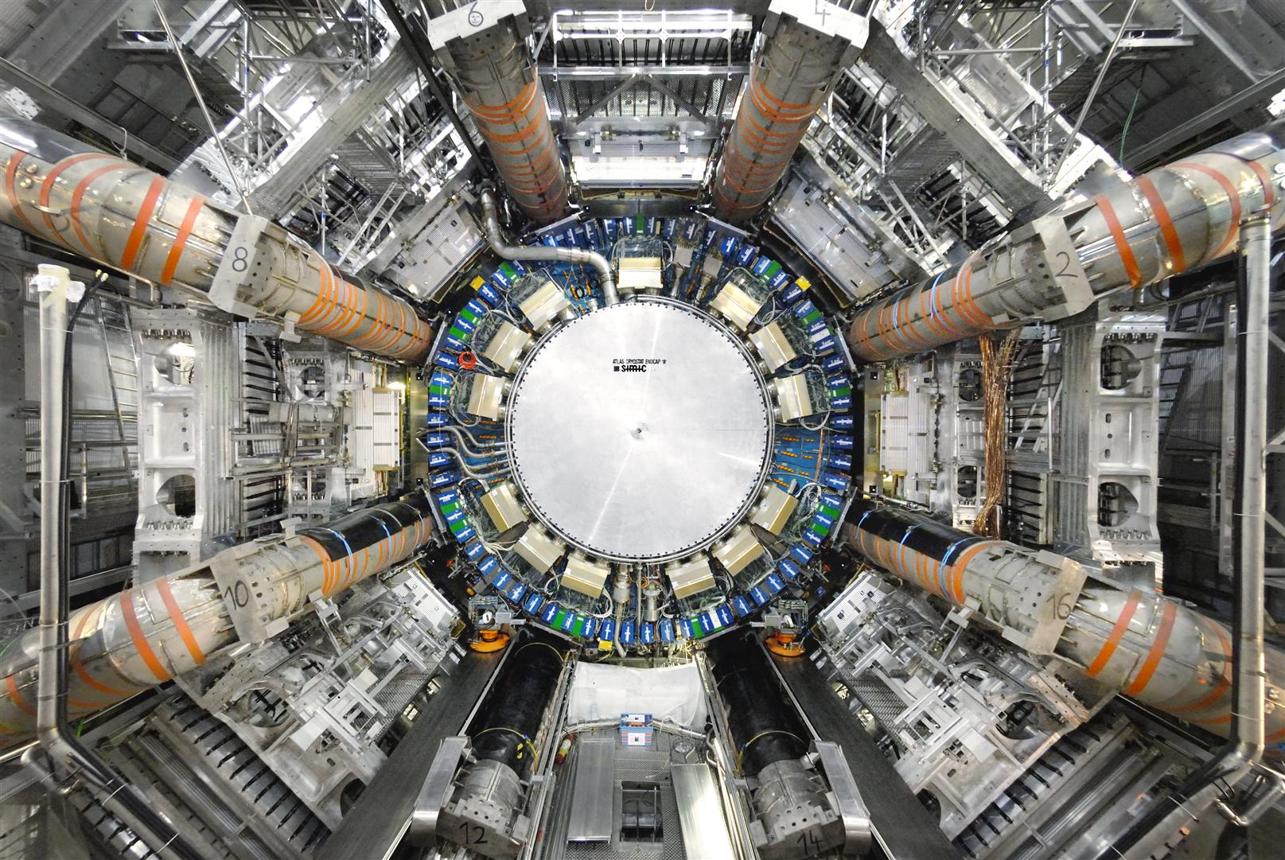
An international research team led by scientists from the University of Oxford used data from the ATLAS experiment at CERN to investigate Z bosons created through Higgs boson decays. Despite existing for only an extraordinarily short time, the particles displayed correlations consistent with quantum entanglement.
The finding, published in Physical Review Letters, represents one of the highest-energy demonstrations of quantum entanglement achieved experimentally and provides researchers with another way to test the foundations of quantum physics.
Quantum entanglement tested at extreme energies
Quantum entanglement occurs when two particles become linked through their quantum states, producing correlations that cannot be fully explained by treating the particles as independent systems.
The phenomenon has been demonstrated in systems ranging from photons and electrons to trapped ions and has become a key area of research for quantum computing, communications and sensing.
However, scientists have continued to investigate whether quantum entanglement can persist in the extreme environment of a particle collider, where particles are produced during highly energetic collisions.
The ATLAS team examined this question by studying pairs of Z bosons generated when Higgs bosons decay. The Higgs bosons themselves are produced when protons collide inside the LHC at energies reaching 13 trillion electron volts.
Z bosons reveal their quantum connection
Z bosons are fundamental particles associated with the weak nuclear force. They are also highly unstable and decay almost immediately after being produced.
Although the Z bosons cannot be observed directly for long, researchers can reconstruct their properties by studying the particles produced in their decays.
In the ATLAS analysis, the Z bosons ultimately produced pairs of electrons or muons. Researchers analysed the directions of these particles to extract information about the spins of the original Z bosons.
The resulting correlations provided strong evidence that the Z boson pairs were quantum mechanically entangled.
The result is particularly significant because it shows that entanglement can be investigated among massive, short-lived particles produced in one of the most energetic experimental environments on Earth.
Extending earlier particle-physics experiments
The research builds on previous efforts to use particle accelerators as laboratories for studying quantum phenomena.
Oxford physicist Professor Alan Barr and colleagues previously helped develop methods for investigating quantum entanglement using high-energy particle collisions. In 2023, the ATLAS experiment reported evidence of entanglement between pairs of top quarks.
Top quarks are the heaviest known elementary particles. Applying similar techniques to Z bosons provides researchers with a different particle system in which to investigate the behaviour of quantum mechanics.
The research also highlights the growing connection between particle physics and quantum information science. Methods developed within quantum information theory can help physicists identify subtle correlations hidden within enormous datasets generated by particle collisions.
Could entanglement reveal new physics?
The latest result is primarily a fundamental physics achievement rather than an immediate technological breakthrough.
The entangled Z bosons cannot simply be converted into a quantum computer or used as a practical communication system. Instead, the experiment gives scientists another powerful method for testing whether the laws of quantum mechanics continue to hold under extreme conditions.
Such measurements could eventually contribute to searches for physics beyond the Standard Model, the framework currently used to describe fundamental particles and their interactions.
Highly precise measurements of quantum correlations could potentially reveal deviations from theoretical predictions, providing clues about phenomena not currently explained by the Standard Model.
More powerful tests could be ahead
The ATLAS detector is undergoing upgrades as CERN prepares for increasingly powerful and data-intensive experiments at the LHC, including the High-Luminosity LHC programme.
Greater amounts of collision data will provide researchers with more opportunities to study quantum effects involving fundamental particles.
The latest finding demonstrates how particle colliders are becoming more than machines for discovering and measuring particles. They are also emerging as laboratories for exploring some of the deepest questions in quantum physics.
By observing entanglement in particles that exist for only an incredibly brief period, physicists are pushing experimental quantum mechanics into a new and remarkably energetic environment.
