
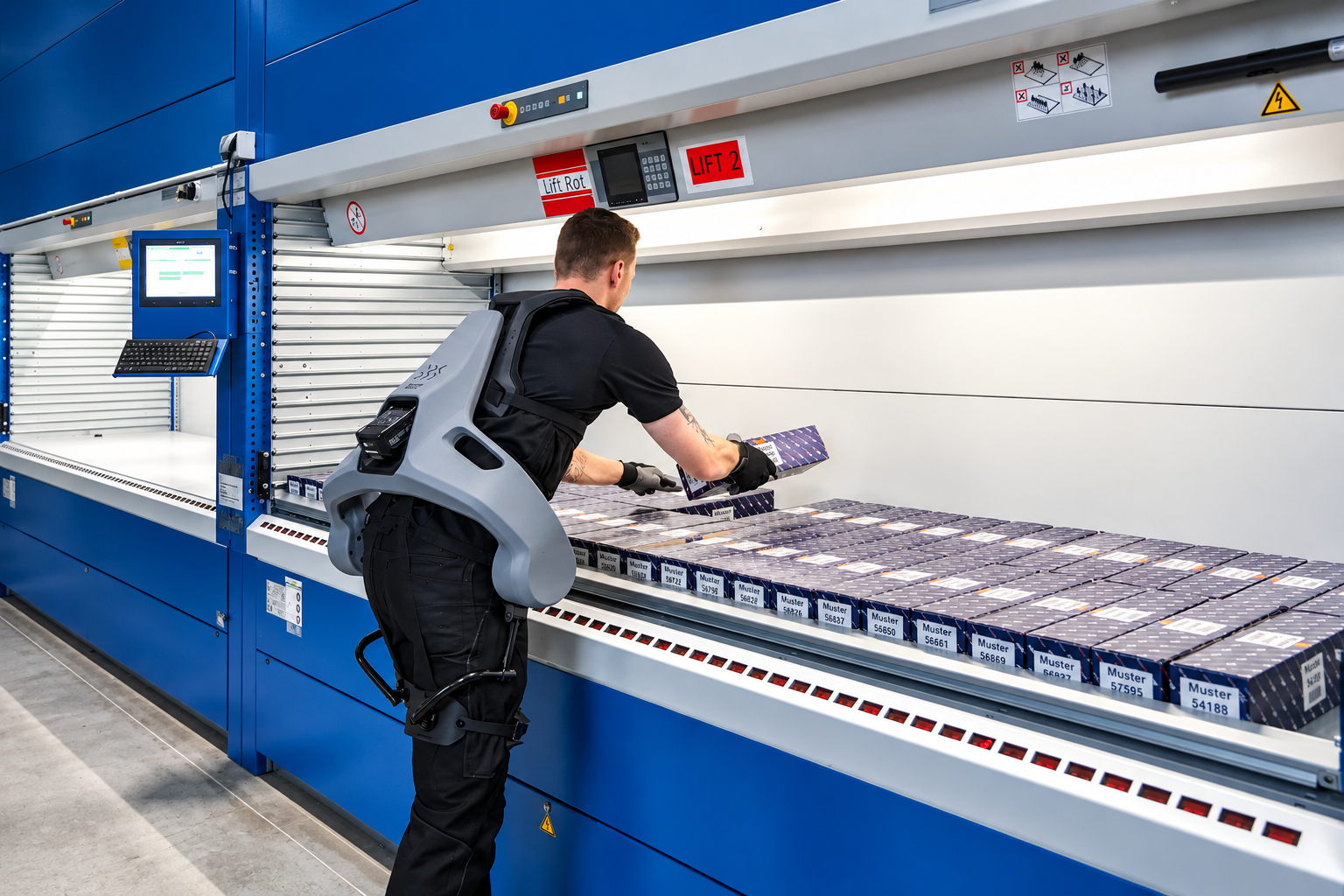
Wearable robotic exoskeletons are gaining traction across manufacturing, warehousing, emergency response and rehabilitation, helping users manage physically demanding tasks and reducing strain during repetitive work.
Human exoskeletons are moving beyond experimental robotics into practical applications, as advances in motors, sensors and control systems make the technology increasingly accessible to commercial and industrial users.
These wearable devices attach to the body and use mechanical structures, with some incorporating powered assistance, to support movement, improve endurance and help users handle physically demanding activities.
Manufacturers Explore Exoskeletons for Workplace Support
Industrial companies are increasingly exploring exoskeleton technology to support workers on production lines and in logistics operations.
IKEA has deployed SuitX exoskeletons across multiple countries to assist warehouse employees handling heavy materials. Automotive and aerospace manufacturers, including Ford, Boeing and Mazda Toyota, have also adopted the technology in selected manufacturing environments.
Depending on the design and task, exoskeletons can provide support to the back, shoulders, hips or legs. This can help workers manage repetitive movements, maintain posture and perform physically demanding activities.
Wearable Robotics for Emergency Response
Exoskeletons are also being evaluated in emergency response and rescue operations, where physical endurance can be critical.
Seattle Mountain Rescue has been testing powered assistive devices designed to support rescuers during demanding hikes and while carrying equipment in difficult terrain.
In Finland, the ExoPELA project has examined whether exoskeletons can help reduce muscular loading and physical strain during rescue and firefighting activities. The research highlights the potential for wearable robotics to support personnel working in challenging conditions.
Military applications have also emerged, with reports of Ukrainian soldiers using powered exoskeletons to assist with carrying heavy equipment and ammunition.
How Robotic Exoskeletons Work
Modern robotic exoskeletons typically combine a wearable mechanical frame with ergonomic attachments, sensors, control systems and, in powered models, electric motors or other actuators.
The equipment assists selected body movements by generating or transferring forces around joints. Lower-body systems can support hip movement during walking or climbing, while upper-body designs can help support the back and shoulders during lifting or repetitive tasks.
Exoskeletons vary considerably in their capabilities. Passive systems use mechanical structures, springs or other mechanisms to redistribute loads, while active systems use powered components to provide additional assistance.
The intended benefits depend on the application, device design and working conditions. Proper fitting, training and task-specific evaluation remain important when introducing the technology into workplaces.
From Early Concepts to Commercial Applications
The idea of using external mechanical structures to enhance human movement dates back more than a century. Inventors patented early wearable assistance concepts in the late 19th and early 20th centuries, followed by more advanced powered systems incorporating electronic controls during the 1960s.
Progress in robotics, sensing technology, materials and control systems has since helped developers create lighter and more practical devices for industrial, medical and consumer applications.
Today, exoskeletons are being developed for several purposes, including workplace assistance, physical rehabilitation, mobility support and endurance during demanding outdoor activities.
The Outlook for Industrial Wearable Robotics
As manufacturers seek ways to support workforce safety and manage physically demanding tasks, exoskeletons could become a more common part of industrial equipment strategies.
However, successful deployment requires more than simply introducing wearable technology. Companies need to assess whether a device suits the task, fits the workforce, integrates into existing processes and delivers measurable benefits without creating new ergonomic risks.
With continued advances in wearable robotics, exoskeletons are emerging as another technology that could reshape how people interact with industrial environments.
