

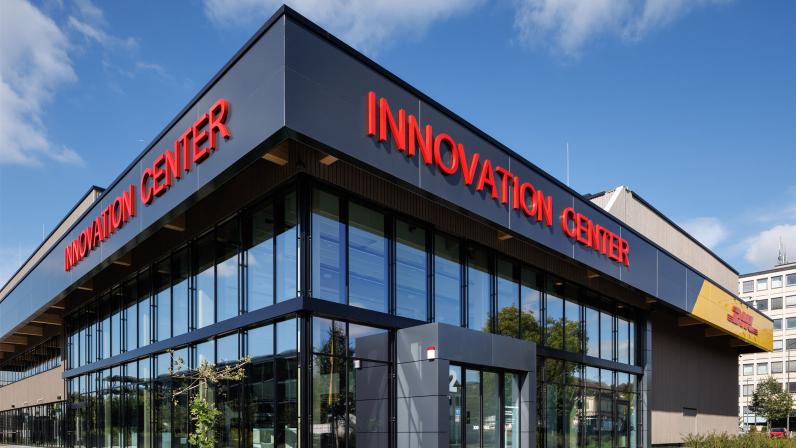
DHL Group has inaugurated its new Europe Innovation Center in Troisdorf, Germany — a major step in its commitment to shaping the future of logistics through bold, customer-focused innovation.
Located near the Group’s headquarters in Bonn, the 5,360-square-meter facility replaces the previous center and supports the development and real-world application of technologies that make global supply chains smarter, more sustainable, and more resilient.
Built from cross-laminated timber and powered entirely by renewable energy, the center operates with zero greenhouse gas emissions and meets DGNB Platinum standards for sustainability. Its modular, flexible design accommodates up to 400 visitors and enables collaborative workshops, events, and co-creation with customers, startups, and partners.
“The new DHL Europe Innovation Center enables collaboration, drives growth, and redefines what’s possible in logistics — by turning ideas into impact,” said Katja Busch, Chief Commercial Officer DHL and Head of DHL Customer Solutions & Innovation.
The facility showcases DHL’s latest advances in AI, robotics, IoT, and green technologies, aligned with the company’s Strategy 2030, which focuses on smart growth, decarbonization, and digital transformation.
A global survey of over 2,500 supply chain professionals, conducted as part of the DHL Logistics Trend Radar, identified AI (44%), Robotics (28%), and ESG (25%) as the top three forces shaping logistics in the coming decade.
DHL is already deploying these technologies at scale — with nearly 10,000 automation and digitalization projects and over 8,000 collaborative robots integrated into operations worldwide.
“The true value of innovation is realized when it’s implemented at scale,” said Rainer Haag, CEO, DHL Supply Chain Europe. “That’s how we deliver real impact for our customers and grow together.”
The Troisdorf center joins DHL’s global network of Innovation Centers in Chicago, Singapore, and Dubai, forming an interconnected ecosystem that identifies emerging trends, tests breakthrough solutions, and accelerates their adoption across regions — driving global progress in logistics and supply chain management.
