

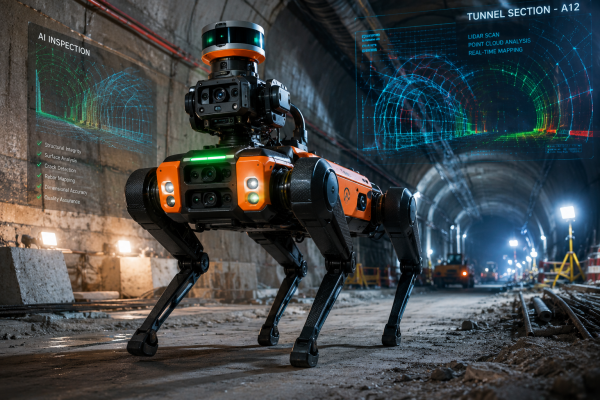
As the global construction industry embraces automation and artificial intelligence, UK-based McLaren Construction has entered into a strategic partnership with physical AI specialist FieldAI to deploy autonomous robots across its construction sites. The collaboration marks a significant step towards smarter, data-driven project delivery and highlights the growing role of robotics in improving productivity, safety and quality management.
The partnership will initially see autonomous quadruped robots deployed to capture 360-degree site imagery, generate point-cloud data and support project progress verification. The robots will also assist with model-to-site deviation analysis, safety inspections and quality assurance, providing construction teams with accurate, real-time information throughout the project lifecycle.
Unlike conventional robotic systems that rely on pre-programmed routes or fixed infrastructure, FieldAI’s autonomous platform enables robots to navigate complex construction environments independently. Powered by advanced AI models that combine machine learning with physics-based reasoning, the robots can adapt to constantly changing site conditions without requiring prior mapping.
Regular automated site scans will create detailed digital records of construction progress, allowing project teams to compare completed work against digital design models. This capability enables early identification of installation deviations, reducing costly rework while improving compliance with project specifications and quality standards.
McLaren Construction expects the technology to strengthen project monitoring, improve quality control processes and provide more comprehensive evidence for regulatory compliance. As the partnership evolves, additional robotic capabilities are expected to be introduced, including support for site logistics, material handling and coordinated multi-robot operations.
The deployment forms part of McLaren Construction’s broader digital transformation strategy, which has already earned the company multiple industry awards for innovation and technology leadership.
Although the project is currently focused on the United Kingdom, the development reflects a broader global trend that is increasingly relevant for Africa’s construction and industrial sectors. As infrastructure investment grows across the continent, autonomous robotics, digital twins, AI-powered inspections and automated site monitoring are expected to become valuable tools for improving project efficiency, reducing safety risks and enhancing quality assurance on major industrial and infrastructure developments.
For Africa’s automotive, industrial and construction sectors, the continued advancement of physical AI demonstrates how intelligent automation is beginning to reshape engineering, manufacturing and project delivery worldwide.
