

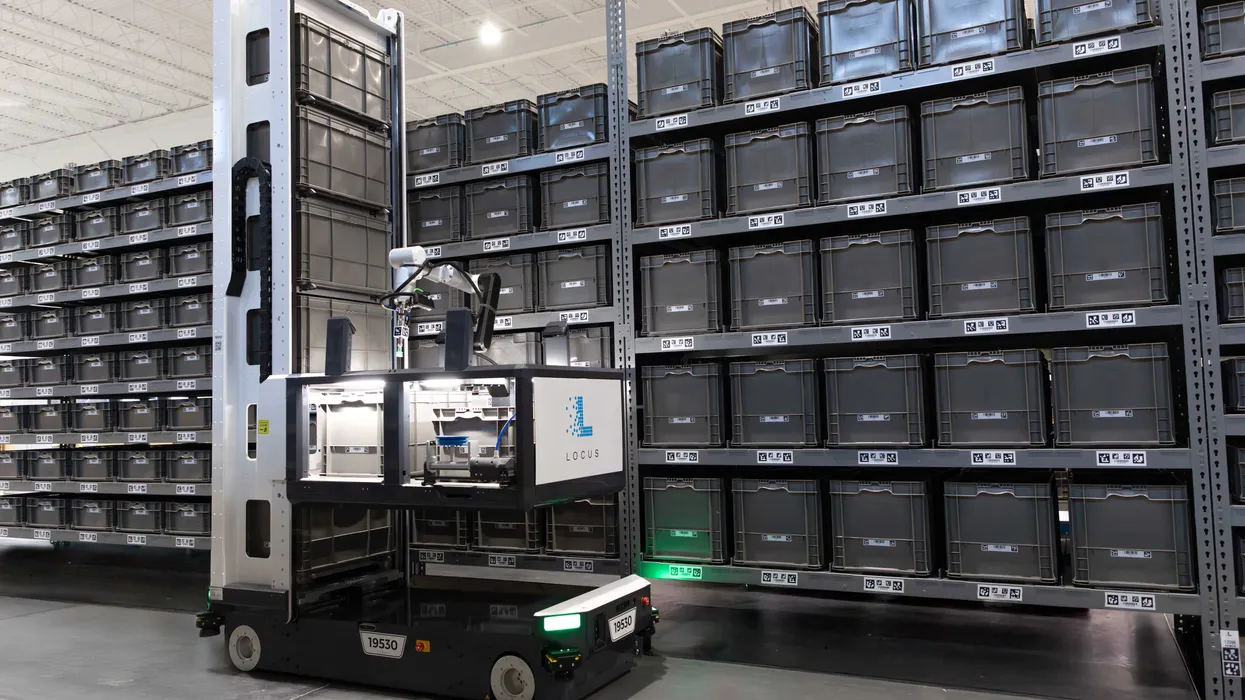
Locus Robotics has introduced Locus Array, a fully autonomous warehouse fulfillment system designed to automate end-to-end warehouse operations with minimal human intervention.
The new solution combines mobile robotics, integrated robotic picking arms, AI-powered perception technology, and autonomous execution capabilities to streamline fulfillment workflows across warehouse environments.
Deployments are already underway with early-access customers in North America, while the company prepares for broader expansion across Europe and the Asia-Pacific region.
Addressing Growing Warehouse Challenges
Warehouse operators continue to face mounting pressure from labour shortages, rising operating costs, and increasingly complex fulfillment demands. According to Rick Faulk, traditional warehouse systems often struggle to adapt to these rapidly changing conditions.
Faulk said Locus Array represents a major shift in warehouse automation by introducing a system-level approach that brings fully autonomous fulfillment into real-world operations at scale.
DHL Among First Companies to Deploy the System
Among the early adopters is DHL Supply Chain, a long-standing global customer of Locus Robotics.
Sally Miller described the deployment as an important step in DHL’s digital transformation strategy, moving beyond traditional assisted picking systems toward high-density autonomous fulfillment.
According to Miller, the technology helps maximise warehouse space, reduce manual handling, and improve operational speed and reliability across supply chain operations.
Key Capabilities of Locus Array
The Locus Array system is designed to support a wide range of warehouse workflows within a single autonomous platform.
Key capabilities include:
- High-density, high-speed order fulfillment with continuous 24/7 operation
- Autonomous handling of picking, replenishment, slotting, putaway, induction, and drop-off tasks
- Up to 90% reduction in manual labour requirements
- Rapid deployment without major facility redesigns or complex infrastructure changes
- Flexible scalability to adapt to changing warehouse layouts, inventory volumes, and demand patterns
The system also integrates with Locus Origin and Locus Vector robots to provide full warehouse SKU coverage within a unified automation environment.
Introducing the Robots-to-Goods Model
Locus Robotics says the launch of Locus Array introduces a new category of warehouse automation known as “Robots-to-Goods” (R2G).
Unlike traditional systems that move inventory through fixed conveyor-based processes, the R2G model allows intelligent robots to travel directly to inventory locations and perform fulfillment tasks within the aisle itself.
This approach reduces unnecessary movement, improves storage density, and enables more dynamic, real-time task allocation across warehouse operations.
Powered by AI-Driven Orchestration
The system is powered by LocusONE, the company’s AI-driven orchestration platform that coordinates robots, workflows, and inventory movement in real time.
By continuously assigning tasks based on operational demand, the platform enables warehouses to scale automation efficiently while maintaining flexibility in fast-changing environments.
As demand for faster, more reliable fulfillment continues to grow, fully autonomous systems such as Locus Array are expected to play an increasingly important role in the future of warehouse and logistics operations.
