

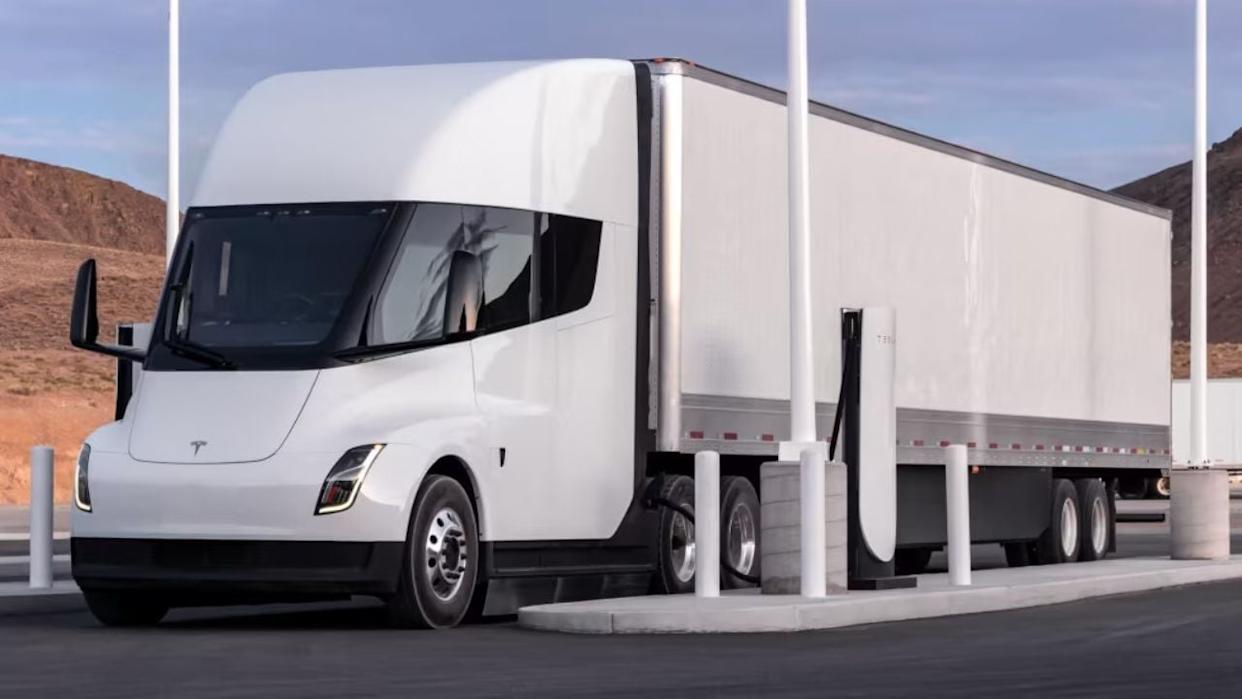
Tesla has officially begun high-volume production of its long-awaited Semi electric truck at its Gigafactory in Sparks, Nevada, marking a major milestone for the company’s commercial vehicle ambitions.
The move signals Tesla’s transition from limited pilot production to full-scale manufacturing, with plans to eventually produce up to 50,000 units annually. The announcement, shared via the social platform X, confirms that production is now ramping at the 1.7-million-square-foot facility.
From ambitious promise to production reality
First unveiled in 2017 by Elon Musk, the Semi was initially expected to enter production in 2019. However, repeated delays pushed the timeline back several years, with only a small number of units delivered to PepsiCo through a pilot programme.
A $3.6 billion expansion of Tesla’s Nevada Gigafactory in 2023 laid the groundwork for large-scale manufacturing, enabling the company to now move toward full production.
Improved performance and efficiency
The production-spec Tesla Semi introduces several upgrades over earlier versions. Weight has been reduced by approximately 450 kg through design optimisations, including a shift to a 48V low-voltage system and improved battery packaging.
The truck is available in two variants:
- Standard Range: Approximately 325 miles at full load
- Long Range: Up to 500 miles
Both models are powered by a three-motor system delivering up to 800 kW, with charging supported via Megawatt Charging System (MCS) connectors capable of reaching 1.2 MW. This enables up to 70% recharge in roughly 30 minutes.
Tesla also claims an efficiency of around 1.7 miles per kWh, positioning the Semi as a strong contender in total cost of ownership—an important metric for fleet operators.
Competitive landscape intensifies
Despite its technological promise, the Semi enters a market that has evolved significantly during its development delays.
Volvo Group, for example, began producing electric trucks in 2019 and currently leads global e-truck deployment. Meanwhile, Daimler Truck’s Freightliner eCascadia dominates the North American Class 8 segment, supported by an extensive service network.
Chinese manufacturers are also gaining ground. BYD continues expanding globally, while startup Windrose Technology is emerging as a cost-competitive challenger, offering comparable range and charging performance at a lower price point.
Scaling production amid cautious expectations
While Tesla’s Nevada facility has a theoretical capacity of 50,000 units per year, industry analysts expect more modest output in the near term, estimating between 5,000 and 15,000 units annually.
Production is closely tied to Tesla’s in-house 4680 battery cell manufacturing, a strategy aimed at reducing reliance on external suppliers and strengthening supply chain resilience.
Looking ahead
Tesla plans to expand the Semi programme into international markets, with Europe expected to follow in 2026. Gigafactory Berlin is likely to play a key role in supplying regional demand.
Although the Semi arrives later than anticipated, its combination of range, efficiency, and charging capability positions it as a serious contender in the rapidly evolving electric trucking market.
As competition intensifies, the success of Tesla’s Semi will ultimately depend on its ability to scale production, deliver on cost advantages, and compete against increasingly capable global rivals.
